the Center for Holy Lands Studies Compare Review
The Holy Land: vii Amazing Archaeological Finds
Holy Land archaeology
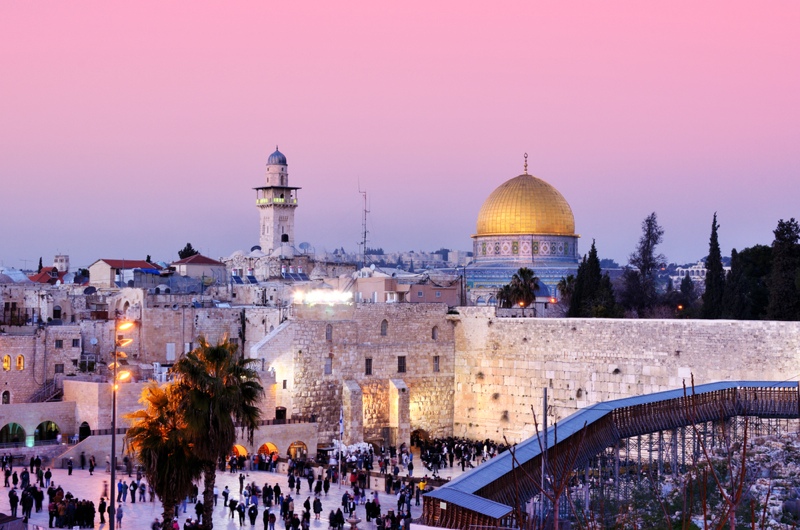
The "Holy State" refers to modern-day State of israel, the Palestinian Territories and, by some definitions, areas close to them. This part of the earth is of great religious importance for Christianity, Judaism and Islam. In this gallery LiveScience takes a look at seven amazing archaeological discoveries made in the region, some very recently. The finds date from the Early on Bronze Age (more than iv,000 years ago) up to the fourth dimension the Byzantine Empire controlled the Holy State, about 1,500 years ago.
Ketef Hinnom silverish amulets
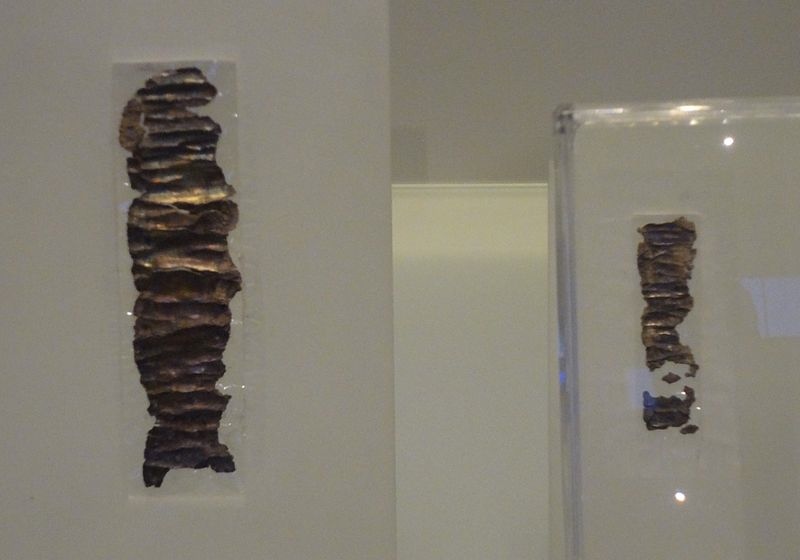
In 1979 two silver mini scrolls (actually amulets in artifact) were discovered at Ketef Hinnom, an archaeological site that now has been incorporated into the Menachem Begin Heritage Center in Jerusalem. Dating to around two,600 years ago they are written in paleo-Hebrew and contain the oldest biblical passage that survives to present day, part of a priestly approval found in Numbers half-dozen:24-26. The amulets say that Yahweh is stronger than evil and a "rebuker of evil." Researchers think the amulets would have offered protection to those who wore them.
Khirbet Qeiyafa
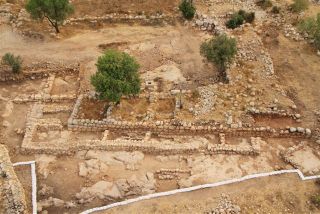
Khirbet Qeiyafa flourished almost 3,000 years ago and is located about 19 miles (thirty kilometers) southwest of Jerusalem. A casemate city wall with 2 gates surrounds the half-dozen-acre (ii.3 hectares) settlement, and some researchers claim it is the biblical metropolis of Sha'arayim. The site may likewise have played an important role during Israel's "United Monarchy" menstruum and, in July 2013, researchers appear they had identified a structure more 10,000 square feet (1,000 square meters) in size as a palace that may accept been used by King David himself.
Massive 'Ocean of Galilee' Structure
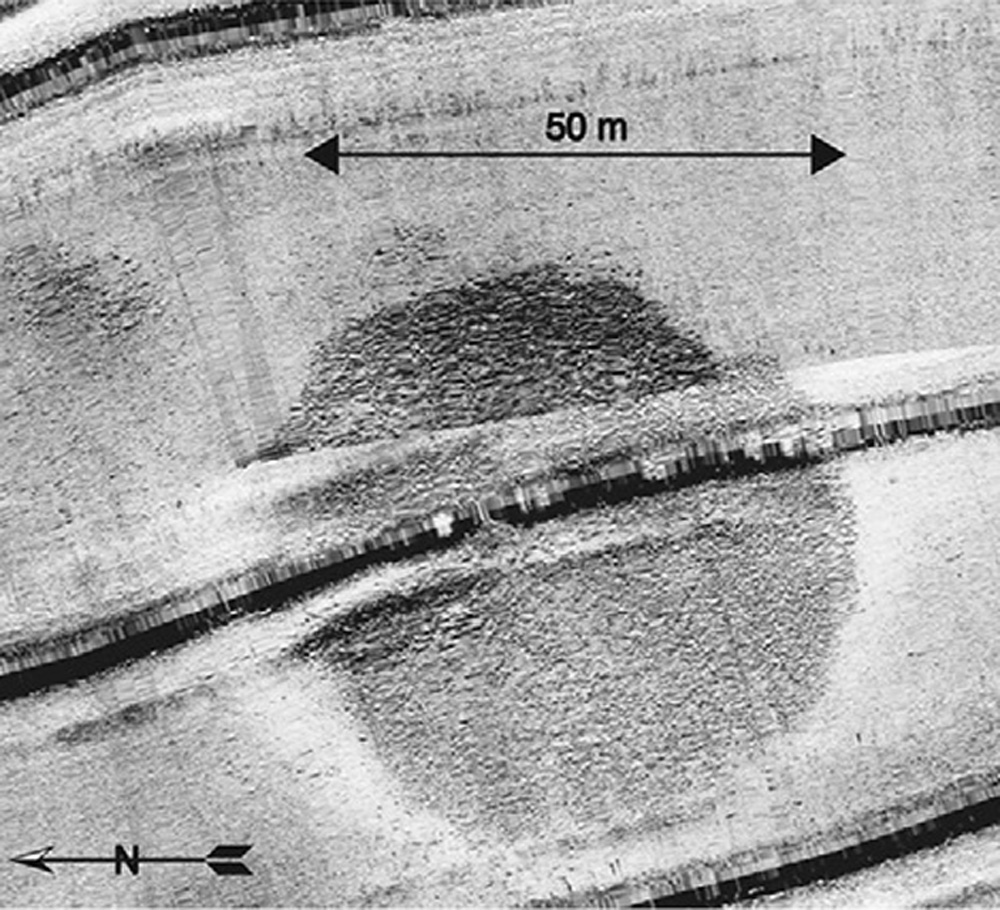
In 2013, researchers reported the discovery of a massive rock cenotaph beneath the waters of the Sea of Galilee. Rising 32 feet (x meters) off the seafloor the structure has a diameter of 230 feet (seventy m), twice the size of the outer circle of tonehenge. It's estimated to weigh about 60,000 tons, heavier than most modern-mean solar day warships. Researchers think information technology may be more than 4,000 years sometime, dating to a fourth dimension when the water levels of the bounding main were lower and a city called "Bet Yerah" or "Khirbet Kerak" stood a mile to the south of the structure. The purpose of the structure is unknown, but cairns, in some instances, were used to mark burials in the ancient globe.
Sea of Galilee boat
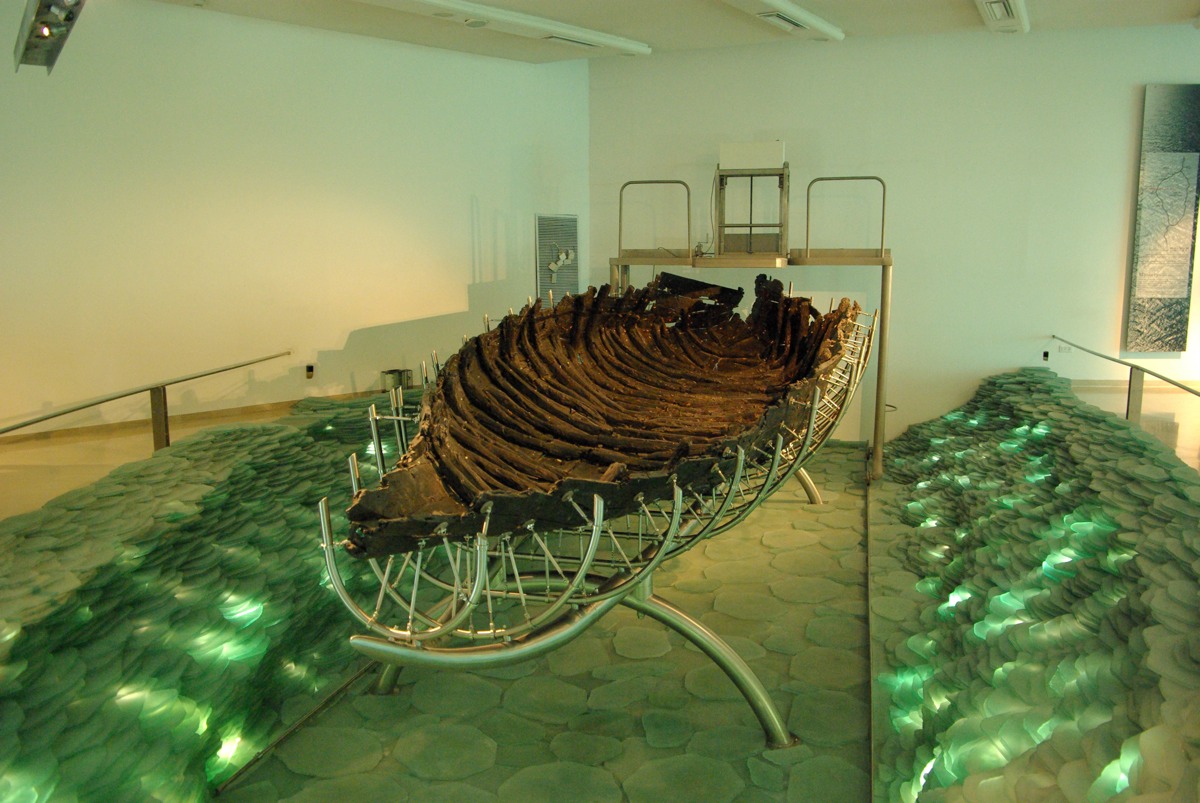
In 1986 two amateur archaeologists, exploring the Body of water of Galilee declension at a fourth dimension when the water level was low, found the remains of a small wooden boat cached in sediment. Professional person archaeologists before long excavated information technology and found it dates to around two,000 years ago. That date has led some to refer to the remains as the "Jesus boat," although in that location is no evidence that Jesus or his apostles used this specific vessel. Recently archaeologists discovered a town dating dorsum more than 2,000 years that was located on the shoreline where the boat was establish.
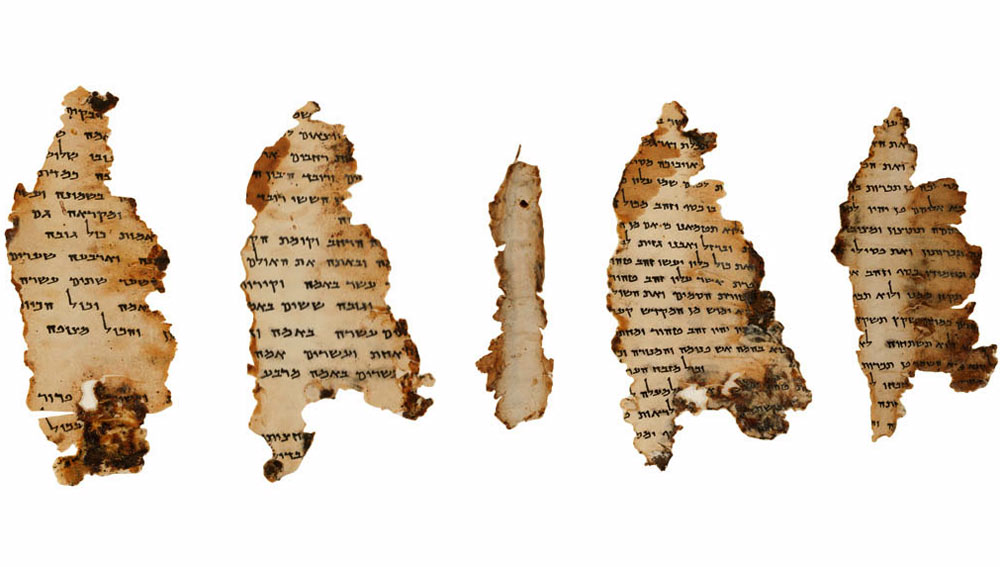
A young shepherd named Muhammed Edh-Dhib first discovered the Dead Bounding main Scrolls in 1946 or 1947 near the site of Qumran in what is now the West Bank. Over the side by side decade, scientists and Bedouin would find more than 900 manuscripts located in xi caves. They include approved works from the Hebrew Bible, including Genesis, Exodus, Isaiah, Kings and Deuteronomy. They too include calendars, hymns, psalms, apocryphal (non-approved) biblical works and community rules. 1 scroll is made of copper and describes the location of buried treasure. The texts date from between roughly 200 B.C. upwards until well-nigh A.D. lxx when the Romans put down a revolt in Jerusalem and Qumran was abandoned. The authorship of the scrolls is a source of debate. A pop theory amid scholars is that a monastic sect called the Essenes lived at Qumran, and they wrote and nerveless the texts.
Masada Fortress
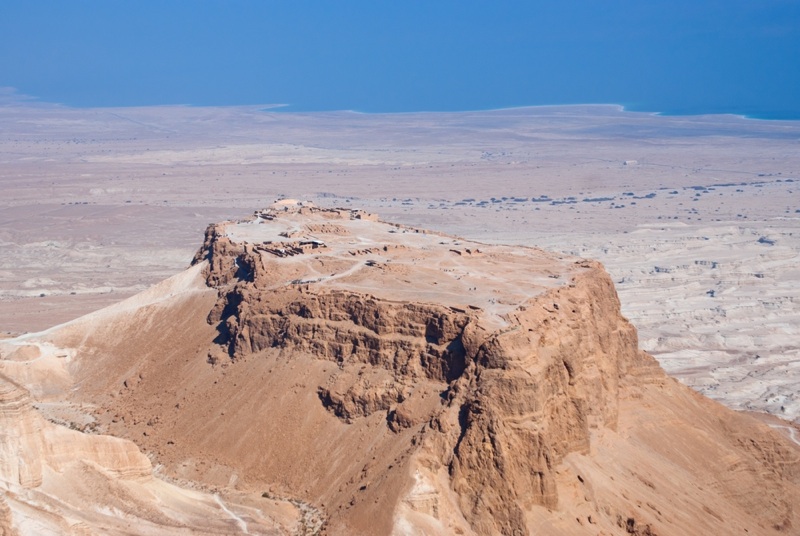
Kickoff identified in 1838, the cliff-summit fortress of Masada is located in Israel near the Expressionless Sea and was the site of a last stand up during a rebellion confronting the Romans. A team led by archeologist Yigael Yadin carried out the most intensive excavations there in the 1960s. Research reveals that King Herod (74 B.C.– 4 B.C.) congenital two palaces with support buildings surrounded past a wall, nearly a mile long, with 27 towers. The site would gain its greatest fame when, later on a rebellion confronting the Romans was crushed in A.D. 70, a group chosen the Zealots occupied the fortress with 960 people and tried to concur information technology confronting a Roman army of about 9,000. In A.D. 73 or 74 the Romans succeeded in building a siege ramp up to the wall, and the remaining defenders decided to take their ain lives rather than give up.
Madaba Map
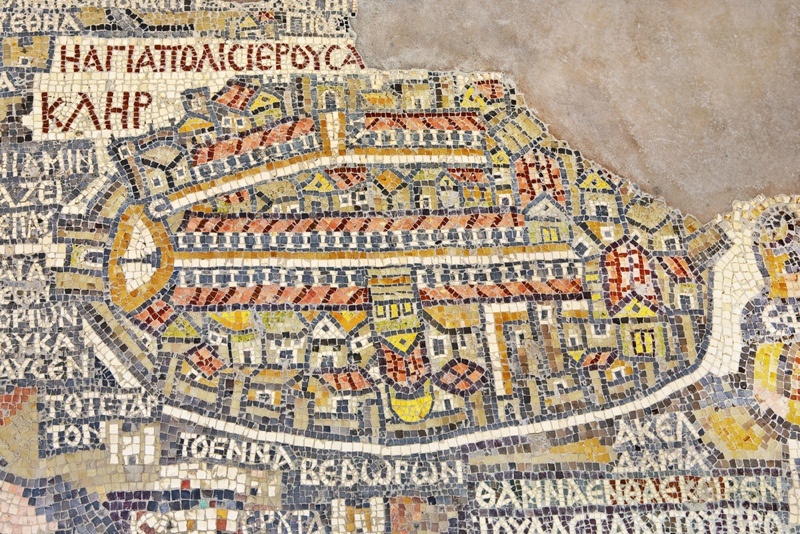
Discovered in a church in Madaba, Hashemite kingdom of jordan, in 1884, the Madaba Map is the oldest surviving cartographic depiction of the Holy State. Created in the grade of a mosaic it dates to somewhere betwixt A.D. 560-565 and originally showed an area that stretched from southern Syrian arab republic to central Egypt. By the fourth dimension it was discovered much of the map was already gone, all the same its remains include a detailed delineation of Jerusalem. "The bird'due south-eye view shows an oval-shaped walled city in the very centre of the map with six gates and twenty-one towers, the colonnaded master thoroughfare … and thirty-six other identifiable public buildings, churches and monasteries," writes Jerome Mandel in an article published in the book "Trade, Travel and Exploration in the Middle Ages: An Encyclopedia" (Routledge, 2000). At the fourth dimension it was created the Byzantine Empire ruled the Holy State.

Owen Jarus is a regular contributor to Live Science who writes nigh archeology and humans' past. He has also written for The Independent (UK), The Canadian Press (CP) and The Associated Press (AP), amidst others. Owen has a bachelor of arts degree from the Academy of Toronto and a journalism caste from Ryerson University.
Source: https://www.livescience.com/40046-holy-land-archaeological-finds.html
0 Response to "the Center for Holy Lands Studies Compare Review"
Post a Comment