Do You Need to Know Cos of Angles for Mcat
I'm guessing that by this point in your MCAT preparation y'all feel like you've parked a dump truck total of information side by side to your desk and shoveled facts into your encephalon until its about gear up to outburst. Then you hit that physics problem. The one that requires you lot to know the sine – or is that cosine? – of 60 degrees.
You lot search through your mental hard bulldoze for references to trigonometry. At that place'southward something almost SOH CAH TOA… and a2 and bii. Oh dear. Something else to add together to the "to memorize" list that's growing to the thickness of your organic chemistry textbook.
At that place are lots of videos and manufactures near tricks for memorizing sine and cosine values, and they are a good starting point, but they aren't actually that helpful for the MCAT. (We'll see why later). All you really need to memorize to do any trigonometry calculation on test day is "syne – bespeak five, point vii, bespeak 9". That's it! Permit's see how this works…
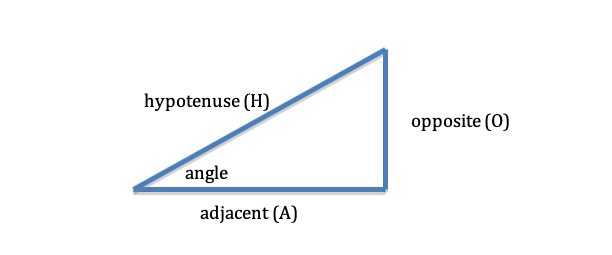
In the physics section of the MCAT, you will need to be able to practise calculations with the sine, cosine, and tangent of five degree measures – 0°, 30°, 45°, 60° and xc°. If students remember anything about trigonometry, it'due south probably SOH CAH TOA (meet below), which reminds us that the sine (S) of an angle is equal to the length of the opposite side of the triangle (O) divided by the hypotenuse (H), the cosine (C) of an bending is equal to the side by side side (A) divided by the hypotenuse (H) and the tangent (T) equals the reverse side (O) divided past the adjacent side (A).
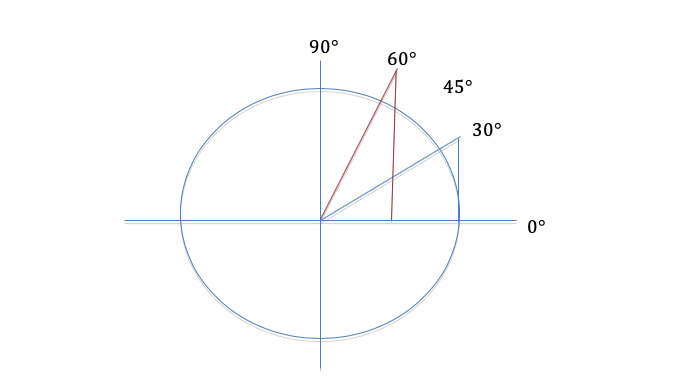
In the moving-picture show beneath, nosotros see two right triangles inscribed over a unit of measurement circle: 1 with its hypotenuse at an angle of xxx° with the x-centrality and one with its hypotenuse at an angle of lx° with the x-centrality. Because sine = opposite/hypotenuse (SOH), the sine of an angle relates the length of the side of the triangle in the y-direction with the hypotenuse. To think this, information technology tin can be helpful to think of "sine" and "y" having similar sounds. That's why we write "sine" as "syne" in the rhyme.
As you increase the caste of the angle, the length of the triangle in the y-direction increases, every bit does the sine of the angle. Sin(0°) = 0 because the "triangle" would have no length in the y-management, and sin(90°) = ane because the "triangle" would take all of its length in the y-direction.
Cosine describes the ratio of the length of the triangle in the x-direction and follows a similar patter except backward. Every bit the angle increases, the length of the triangle in the 10-management decreases, every bit does the cosine of the angle. The cosine of 0° = 1 and the cosine of 90° = 0.
What about the values for sine and cosine for the rest of the angles? Here's where the point 5, point vii, point 9 role of the rhyme come in.
Permit'southward begin with sine or "syne" from the rhyme. The trick that people often teach to memorize the sine of mutual angles is to begin by writing an empty foursquare root sign divided by 2.

At present, nether the square root sign, write the numbers 0, 1, 2, iii and 4 in society.

Some of these fractions simplify nicely to decimals, but the sine of 45° and sixty° won't.

Near videos and articles pedagogy this topic leave y'all here, but because you don't take the luxury of working with a estimator, memorizing quantities like  doesn't actually assistance very much. It is better instead to memorize decimal approximations of and
  , which is where the rhyme comes in. ≈ 0.seven and ≈ 0.9.
If you have to exercise a trig calculation with a sine, you lot tin quickly jot down sin(0°) = 0, sin(90°) = 1 and call up the rhyme, "syne – betoken 5, indicate 7, point 9" (over again "syne" because sine is telling us nigh the y-direction of the triangle).

If you expect back at the unit circle, y'all see that the cosine values for each of these angles are just the opposite of the sine values. So the cosine of 0° = 1, cosine of 30° = 0.9, etc. If you need the cosine, you can just jot downwardly the values of sine and then put them in the reverse club, no memorization necessary.

Finally, if y'all need the tangent, carve up sine past cosine. If you lot take any problem remembering what to split by what, sine is already above cosine in the table, so you can recollect of the dividing line between the two every bit the fraction bar.

The tangent of 0°, 45° and 90° are piece of cake to calculate. For the tangent of 30° and 60°, yous can get a "close enough" reply by approximating 0.9 with i.

The actual value of tangent(30°) ≈ 0.57 and tangent(lx°) ≈ 1.7.
Whew. With all of that fresh in our minds, permit's do a sample trouble:
A child begins to pull a toy behind her with a force of 8 Due north at an bending of 45° with the ground. The initial acceleration of the toy is 2 yard/south2. What is the mass of the toy?
a) ane.63kg
b) 2.84kg
c) 4.00kg
d) 6.21kg
The formula relating force, mass and acceleration is F = Ma. Considering we want to use forcefulness and acceleration to find the mass, we dissever both sides past the dispatch to arrive at the formula M = F/a.
Equally with many physics problems, information technology's helpful to depict a sketch of what is going on. Here'south a kid pulling a toy… um… something or other.

Both force and acceleration are given in the problem; still, the eight N of strength being applied to the toy is at a 45° angle. Some of that strength is pulling the toy in the y-direction, and some of the force is pulling it in the x-direction. Because the problem is asking virtually the toy existence pulled along the ground and not up into the air, we're interested in the x-component of the force.
We first remember our rhyme, "syne – bespeak 5, point 7, point 9" and know that we are going to be using cosine in this problem, not sine. Therefore, to calculate the x-component of the force, we have Fx = F * cosine(45°). A quick wait at our tabular array of sine and cosine values shows that cos(45°) = 0.7 so Fx = F * cosine(45°) = viii * 0.7 = 5.6. (Know your multiplication tables!)

Filling in the formula M = F/a with our newly calculated F10 from the problem, we get Yard = 5.six/2 ≈ 6/two = 3kg, which is closest to answer b) 2.84kg.
Another case:
A tow truck is pulling 25,000 kg machine with a tow hook that meets the auto at an angle of 30° with the ground. How much force must the tow truck utilise to pull the motorcar with an initial dispatch of 3 m/s2?
a) 33,612N
b) 50,319N
c) 75,000N
d) 86,206N
Here's a quick film of our scenario.
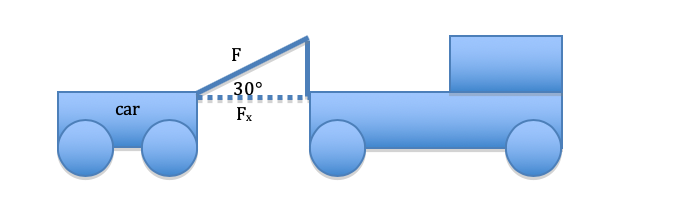
Hither, the strength needed to pull the car in the x-direction can be calculated using the formula Ften = Ma.
In this scenario, we're given the mass of the car and the acceleration in the problem. The required force in the ten-direction is Fx = 25,000kg * 3 g/s2 = 75,000N. Expressed in scientific annotation, this is 7.5 x ten4 N.
However, considering the truck is towing the car at an angle of xxx°, the truck is going to demand more force than that, because information technology is interim on the car in both the x- and y-directions.
In the previous problem, nosotros saw that Fx = F * cos(Θ) where Θ is the degree of the angle, which in this case is 30°. Reviewing our table of sine and cosine values, we run into that cos(xxx°) ≈ 0.9. Expressed in scientific notation, this is 9 ten 10-one.
To solve for F, split each side of the equation by cos(Θ), which gives the formula 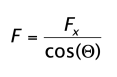 .
.
Nosotros re-express Ften equally 75 x xthree North rather than 7.five x 104 Due north to make the partition problem a petty easier.
The result is 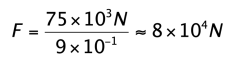 which is closest to answer d). Notation that this has to exist the correct reply because information technology'southward the simply answer choice that was greater than 75,000N.
Make sure to check out the residual of the MCAT Tips and Tricks Series:
- Part I – Converting between units in the metric arrangement
- Part II – Calculating logarithms without a computer
- Office III – Using approximations to tackle circuitous calculations
- Part IV – Unit of measurement conversions in eight easy steps
Source: https://www.studentdoctor.net/2019/02/09/the-one-about-trigonometry/
0 Response to "Do You Need to Know Cos of Angles for Mcat"
Post a Comment